
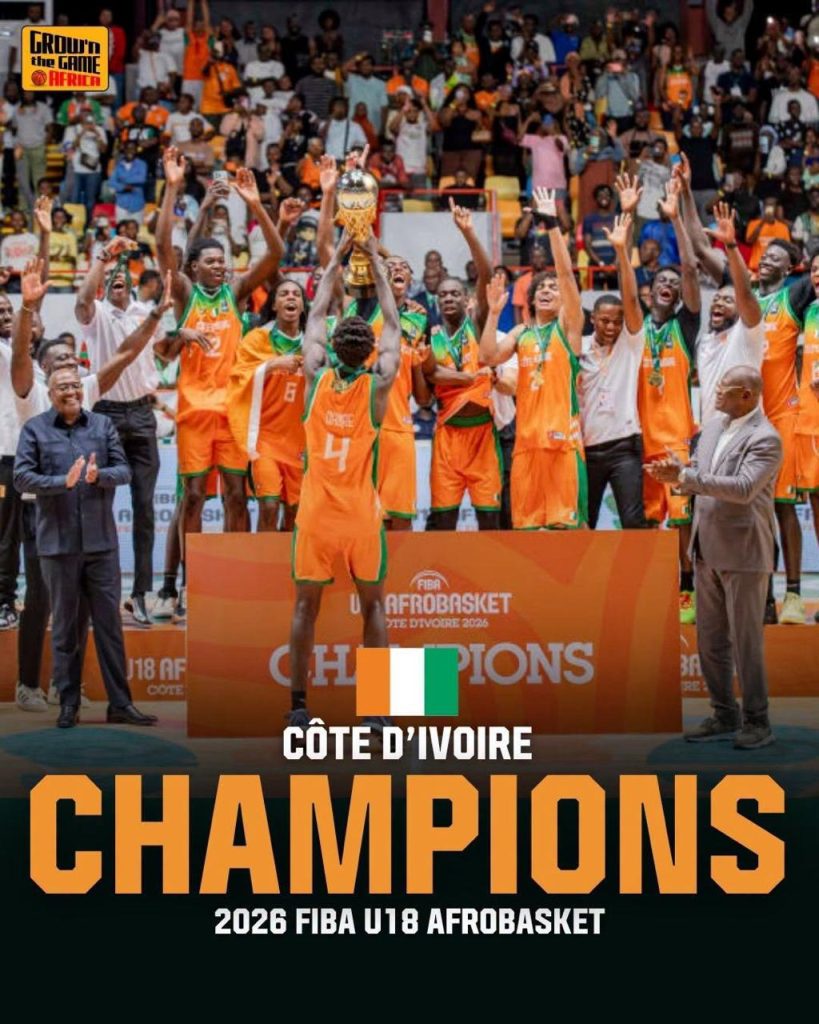
Championship Game & Complete Tournament Breakdown
Championship Overview
The 2026 FIBA U18 AfroBasket in Abidjan, Côte d’Ivoire, concluded with the host nation producing one of the most impressive championship runs in recent African junior basketball. Côte d’Ivoire defeated Senegal 73–51 in the championship game on August 16, finishing the tournament with a perfect 6–0 record and capturing its first U18 African championship. The victory was particularly significant because Côte d’Ivoire had not reached the U18 championship game since 2012. The tournament also served as a qualifier for the 2027 FIBA U19 Basketball World Cup, with the finalists earning Africa’s two qualifying places.
Côte d’Ivoire 73, Senegal 51
Côte d’Ivoire controlled the championship game almost from the opening possession. The home team established a 6–0 advantage before Senegal could settle into the contest, and the Ivorians used their athleticism, defensive pressure and transition offense to create separation. Jean-Philippe Aka provided an early spark with a transition dunk, while Nathan Djako’s presence in the starting lineup gave Côte d’Ivoire another dynamic scoring option. The hosts led 16–7 after the first quarter, forcing Senegal to play from behind throughout the remainder of the game.
Senegal attempted to respond during the second quarter behind Pape Ndiaye, Mouhamed Badiane and Pape Diallo, but Côte d’Ivoire consistently had an answer. Senegal’s offense had difficulty generating efficient opportunities against the Ivorian defense, while Côte d’Ivoire continued attacking the basket and exploiting mismatches created by its pick-and-roll game. The hosts entered halftime with a 34–24 lead, giving them a 10-point cushion despite Senegal’s efforts to remain within striking distance.
The third quarter was the decisive stretch. Djako immediately changed the complexion of the game by knocking down consecutive three-pointers, followed by a Siincere Hudson layup. Côte d’Ivoire extended its advantage to 18 points and eventually reached a 55–34 lead at the end of the third period. At that point, Senegal was forced to chase the game offensively, which played directly into Côte d’Ivoire’s transition-oriented style. The hosts combined perimeter shooting with pressure defense and athletic finishing to turn a competitive championship matchup into a comfortable victory.
Côte d’Ivoire closed the fourth quarter professionally. Karl-Randell Kouame-Zeze and Medard Dabire hit back-to-back three-pointers early in the period, effectively eliminating any realistic possibility of a Senegal comeback. Nathan Djako finished with a game-high 22 points, while Jean-Philippe Aka added 13 points. Point guard Jason Ake had an outstanding all-around performance with 7 assists and 9 rebounds, while Deh-Dimitri Azema and Chris Echui each collected 10 rebounds. Senegal was led by Pape Faye with 15 points and 6 rebounds, while Fredric Mane scored 12.
Why Côte d’Ivoire Won
The championship was ultimately decided by Côte d’Ivoire’s combination of guard play, athleticism, defensive versatility and home-court confidence. The Ivorians had multiple players capable of creating offense rather than relying exclusively on one scorer. Djako was the primary scoring catalyst, while Ake controlled the game from the point, and Kouame-Zeze, Hudson and Aka supplied additional athleticism and perimeter/transition production. The frontcourt combination of Azema and Echui also provided the rebounding foundation necessary to prevent Senegal from generating second-chance opportunities.
The tournament statistics reinforce the quality of Côte d’Ivoire’s backcourt. Jason Ake finished among the tournament leaders in assists at 5.7 per game, while Djako averaged 17.5 points per game. The hosts also demonstrated considerable offensive firepower during the group stage, averaging approximately 90 points per game, before their opponents forced them into more defensive oriented games during the knockout rounds.
Tournament Breakdown
1. Nathan Djako: Côte d’Ivoire
Tournament MVP
Djako was the tournament’s most important individual player and the centerpiece of the eventual champions. The young Ivorian guard averaged 17.5 points per game over six games and saved one of his best performances for the championship game, scoring 22 points against Senegal. His ability to create offense, attack gaps, shoot from the perimeter and play with pace made him extremely difficult for opposing defenses to contain.
From a scouting perspective, Djako’s most impressive characteristic was his ability to impact winning without needing the offense completely built around him. Côte d’Ivoire had several capable offensive players, yet Djako consistently provided shot creation and perimeter pressure. His performance in the final confirmed why he was ultimately selected as tournament MVP.
2. Harinosy A’Ranty Rasetriarivony — Madagascar
Rasetriarivony was arguably the tournament’s most complete individual statistical performer. He averaged 18.2 points, 6.7 rebounds and 7.2 assists per game, while also averaging 2.7 steals. He led the tournament in assists and ranked near the top in scoring and efficiency.
His value went beyond scoring. Rasetriarivony functioned as Madagascar’s primary creator, allowing him to influence the game as a scorer, passer and rebounder. His ability to handle the ball and generate offense for teammates made him one of the most intriguing perimeter prospects in the tournament. Madagascar ultimately finished seventh, but Rasetriarivony’s individual production stood out regardless of the team’s final position.
3. Ngaba Yaya — Chad
Yaya was arguably the tournament’s most dominant interior statistical performer. He averaged 17.3 points and 13.2 rebounds per game, while leading the entire tournament in rebounding and blocks at 3.2 per game. He also ranked first in overall efficiency at 24.7 per game.
His production was particularly impressive because Chad was competing against several of Africa’s more established basketball nations. Yaya gave Chad a legitimate inside-out offensive option and consistently controlled the defensive glass. His combination of rebounding shot blocking and scoring made him one of the most physically impactful players in Abidjan.
4. James Minlend — Cameroon
Minlend emerged as Cameroon’s primary offensive weapon during a tournament in which Cameroon ultimately captured the bronze medal. He averaged 14.8 points and 5.5 rebounds per game while helping Cameroon finish 5–1.
His tournament was particularly impressive because Cameroon reached the semifinals and defeated Chad in the quarterfinals before falling to Côte d’Ivoire 62–57. Minlend’s ability to create offense and produce in pressure situations made him an important part of Cameroon’s successful campaign. He earned a place on the All-Tournament Team.
5. Code Mbengue — Senegal
Mbengue was the defensive and interior anchor for Senegal and an important reason the Teranga Lions reached the championship game. He averaged 11.3 points and 10.0 rebounds per game, giving Senegal a consistent presence around the basket.
Although his championship-game production was limited to two points, his overall tournament contribution was considerably greater. Senegal relied on his length, rebounding and physicality throughout the competition. His selection to the All-Tournament Team reflects his impact over the entire six-game campaign rather than one performance.
6. Mehdi Berrada — Morocco
Berrada was one of the tournament’s leading scorers, averaging 17.6 points per game, second overall according to FIBA’s final tournament leaderboard.
His scoring production was especially noteworthy because Morocco did not advance into the tournament’s medal round. Berrada demonstrated the ability to shoulder a significant offensive load and emerged as one of the competition’s more productive individual scorers.
7. Jason Ake — Côte d’Ivoire
Ake was one of the most important complementary players on the championship team. He averaged 5.7 assists and 5.7 rebounds per game, ranking among the tournament leaders in assists.
His championship-game performance illustrated his value perfectly: 7 assists and 9 rebounds. Ake’s ability to organize the offense, rebound from the guard position and facilitate for Djako, Aka and the Ivorian wings allowed Côte d’Ivoire to play with considerable pace and balance.
8. Karl-Randell Kouame-Zeze — Côte d’Ivoire
Kouame-Zeze was an important part of Côte d’Ivoire’s deep perimeter rotation. FIBA identified him alongside Djako as one of the guards who had been instrumental to the hosts’ success even before the knockout rounds. He also delivered a critical moment in the championship game by hitting a three-pointer early in the fourth quarter as Côte d’Ivoire put the game beyond Senegal’s reach.
For scouting purposes, his value was connected to the larger Ivorian backcourt structure: opponents could not simply overload their defense toward Djako because Côte d’Ivoire had additional ballhandlers and shooters capable of punishing defensive rotations.
9. Daryl Georges Mbinguis — Gabon
Mbinguis finished the tournament as the leading three-point shooter, earning one of the tournament’s individual statistical awards.
His recognition is significant because perimeter shooting remains one of the most valuable translatable skills for young African prospects. Although Gabon did not contend for a medal, Mbinguis provided a notable shooting profile that deserves continued monitoring in future international competitions.
10. Ramy Magdy — Egypt
Magdy was one of Egypt’s primary offensive contributors. FIBA identified him alongside Ahmed Youssef Hendawy, Mohamed Mahmoud Bakry and Belal Sohaib as part of the group responsible for carrying Egypt’s distributed offensive attack.
Egypt reached the quarterfinals before losing 67–57 to Côte d’Ivoire, and subsequently finished sixth after losing the fifth-place game to Tunisia. Magdy’s performance was noteworthy because Egypt entered the tournament as one of the continent’s established junior basketball programs and had enough perimeter talent to challenge the eventual champions.
Other Prospects Worth Monitoring
Several additional players deserve attention despite not making the official All-Tournament Team. Abdul Karim Diallo provided Mali with interior size and defensive presence, while Felix Deumi, Daryl Baya and Ronny Ewanke formed an important frontcourt group for Cameroon. FIBA specifically highlighted Baya and Ewanke after they each scored 18 points in Cameroon’s 77–49 quarterfinal victory over Chad.
For Tunisia, Adem Rafrafi was an important perimeter creator, while Edriss Toumi provided scoring and size on the wing. FIBA identified both as major pieces of Tunisia’s attack entering the quarterfinals.
Final Tournament Assessment
The 2026 U18 AfroBasket was an especially interesting tournament from an international scouting perspective because it featured several different prospect archetypes. Côte d’Ivoire produced the tournament MVP in Djako and demonstrated the value of a deep, athletic guard rotation. Madagascar produced perhaps the most versatile statistical performer in Rasetriarivony. Chad produced the tournament’s leading rebounder and shot blocker in Yaya. Cameroon showed that its development pipeline remains capable of producing high-level young talent, while Senegal once again demonstrated its ability to develop physically mature and defensively versatile prospects.
From a prospect-development standpoint, the five players who most clearly separated themselves over the entire tournament were Nathan Djako, Harinosy A’Ranty Rasetriarivony, Ngaba Yaya, James Minlend and Code Mbengue. They were appropriately selected for the All-Tournament Team, and their statistical production, team impact and performances in the knockout stage support those selections. Behind that group, Mehdi Berrada, Jason Ake, Karl-Randell Kouame-Zeze, Ramy Magdy and Daryl Georges Mbinguis are among the players who deserve continued international scouting attention.
The biggest overall story, however, was Côte d’Ivoire. The hosts went 6–0, defeated Egypt in the quarterfinals, beat Cameroon in the semifinals and then overwhelmed Senegal in the championship game. The victory ended a long wait for an Ivorian U18 title and demonstrated that the country’s current youth generation has significant potential. It also gives Côte d’Ivoire and Senegal the opportunity to represent Africa at the 2027 FIBA U19 Basketball World Cup, where these prospects will receive an even larger international stage.
Final Medal Standings
1. 🥇 Côte d’Ivoire — Gold
2. 🥈 Senegal — Silver
3. 🥉 Cameroon — Bronze
4. Mali
5. Tunisia
6. Egypt
7. Madagascar
8. Chad
The official FIBA tournament results confirm Côte d’Ivoire’s 73–51 championship victory over Senegal and Cameroon’s 73–69 win over Mali for third place.
Scouting takeaway: If the purpose of this tournament is NBA/NCAA/international prospect identification, Djako and Rasetriarivony are the two most intriguing perimeter prospects, Yaya is the most statistically dominant interior prospect, Minlend is one of the more interesting two-way wings, and Mbengue provides the strongest combination of size, rebounding and defensive utility among Senegal’s core players.


